
Euroacademia Conferences
 Europe Inside-Out: Europe and Europeanness Exposed to Plural Observers (9th Edition)April 24 - 25, 2020
 Identities and Identifications: Politicized Uses of Collective Identities (9th Edition)June 12 - 13, 2020
 8th Forum of Critical Studies: Asking Big Questions AgainJanuary 24 - 25, 2020
 Re-Inventing Eastern Europe (7th Edition)December 13 - 14, 2019
 The European Union and the Politicization of Europe (8th Edition)October 25 - 26, 2019
 Identities and Identifications: Politicized Uses of Collective Identities (8th Edition)June 28 - 29, 2019
 The European Union and the Politicization of Europe (7th Edition)January 25 - 26, 2019
- 7th Forum of Critical Studies: Asking Big Questions AgainNovember 23 - 24, 2018
 Europe Inside-Out: Europe and Europeanness Exposed to Plural Observers (8th Edition)September 28 - 30, 2018
- Identities and Identifications: Politicized Uses of Collective Identities (7th Edition)June 14 - 15, 2018
Papers
Europe in Search of Europeans: The Road of Identity and Myths
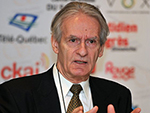
I contend that a particularly unfortunate cultural choice made by the EU was to distrust and sidestep the nations (as configurations of culture, not to be confused with the states), and to opt for a top-down process of governance. In order to break this pattern, I suggest that the EU will have to find a way to mend fences with the nations in order to i) put an end to a long-standing detrimental tension, ii) harness rather than stifle the nations’ still substantial symbolic resources and energy, and iii) secure a platform to build new European myths.
(Re)Constructing Identities: Post-Soviet Art of the Baltic Countries at Venice Biennale 1999
My paper addresses the importance of a relatively new discourse within our discipline - the history of exhibitions - and its role in the post-Soviet context of the regional art history of the Baltic States. I am proposing a case study on the first participation all of the Baltic countries in 1999 Venice Biennial.
The Eastern European Identity in Verbatim Theatre
Using verbatim technique as a main method of storytelling, he often combines it with materials from other sources such as newspapers, judicial documents etc. In this play he not only raises the question of Eastern European identity, but analyses the ways how it is perceived by the Western people.
To Build Strong Children: Toledo, Ohio as a Case Study in Arts Diplomacy
Using a methodology derived from the World Café model, students interviewed members of this marginalized and underserved community and discussed what they wanted the mural to say and achieve. This talk will discuss the aims, process, and short-term legacy of this project, and will propose applications of this approach in European countries such as Denmark, which are currently struggling with the integration of Eastern and Western populations.
Participatory Urban Replaning and Artistic Street Activities in St. Petersburg
In this presentation I will investigate how street activities and artistic guerrilla actions reflect upon the political situation, social disparity and economic insecurity in Russia by taking the example of the city of St. Petersburg. The self-proclaimed and widely acknowledged “cultural capital” of Russia owns the biggest collection of European and Russian art as well the largest open air collection of baroque and classic architecture in Russia.
Temporal City. Exploring Urban Change in Tallinn, Estonia. Typologies of Indeterminate Landscapes
The paper looks at urban indeterminacy in post-socialist Tallinn. I suggest that through typomorphological analysis, observing, documenting and analysing (creating 'eclectic atlases' (Boeri, 2003) of culturally, socially or economically motivated (temporary) appropriations of indeterminate sites and mapping continuous urban change, a basis can be created for developing a new model of cooperation between stakeholders in planning, redefining the role of an urban planner as well as influencing policy making in terms of re-conceptualising developing private property in relation to the wider urban context.
Estimating Barro Misery Index in Democratic States with Application in Albania: 2005 – 2014
In the present study we develop a statistical analysis of the Barro misery index and its components in contemporary democratic states with application in Republic of Albania during the period January 2005- December 2014.
The Determinants of Profitability: Evidence from Croatian Construction Sector
The authors analyze theoretical background and use empirical research to investigate the relation between profitability and selected determinants like price cost margin, concentration index, growth, size, material costs and lagged profitability. Special remarks are given with review of construction sector importance for the growth of the Croatian economy and repercussions of global financial crises. According to that, the empirical part of article use generalized method of moments for dynamic panel model which showed significant results. Overall, the results showed strong relationship between company size, concentration index, growth, lagged profitability and profitability besides number of employees.
Foreign Direct Investment in Dynamics of Endogenous Economic Growth in the Central East European Countries
The methodology of this article is based on the analysis of the models of endogenous growth to reveal the relationship between foreign direct investment and the economy's rate of growth in the Central East European countries and to explore what macroeconomic adjustment is necessary for creation of effective aggregate demand for innovations and transition to knowledge-driven model of sustainable economic growth.
Performing Corruption in Ukraine
This paper deconstructs the idea of corruption as it relates to Ukraine. This is achieved through six vignettes: (i) a conference performance by a leading international expert on Ukraine's political-economy; (ii) the potential of the idea of corruption to harness popular resentment towards commercial and political elites particularly during election campaigns; (iii) the way Ukraine performed the role as a laboratory in which the World Bank experimented with the idea of corruption;