
Euroacademia Conferences
 Europe Inside-Out: Europe and Europeanness Exposed to Plural Observers (9th Edition)April 24 - 25, 2020
 Identities and Identifications: Politicized Uses of Collective Identities (9th Edition)June 12 - 13, 2020
 8th Forum of Critical Studies: Asking Big Questions AgainJanuary 24 - 25, 2020
 Re-Inventing Eastern Europe (7th Edition)December 13 - 14, 2019
 The European Union and the Politicization of Europe (8th Edition)October 25 - 26, 2019
 Identities and Identifications: Politicized Uses of Collective Identities (8th Edition)June 28 - 29, 2019
 The European Union and the Politicization of Europe (7th Edition)January 25 - 26, 2019
- 7th Forum of Critical Studies: Asking Big Questions AgainNovember 23 - 24, 2018
 Europe Inside-Out: Europe and Europeanness Exposed to Plural Observers (8th Edition)September 28 - 30, 2018
- Identities and Identifications: Politicized Uses of Collective Identities (7th Edition)June 14 - 15, 2018
Papers

Tor Pignattara as Rome’s Banglatown: The Suburb as a Feminine, Racialized Spacetime
The perceived “invasiveness” and “aggressiveness” of Bangladeshi settlement has engendered over the years a process of gendered racialization that simultaneously racialized and feminized Tor Pignattara and the Bangladeshi community residing there, thus producing an alignment of Bangladeshi–ness with exoticized/exoticizing non-whiteness. This research investigates the spatiotemporal practices that structure the determining conditions of social life in Banglatown through a new materialist approach.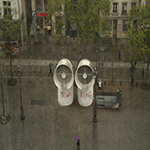
Politics With a Wrecking Ball: Demolition in Contemporary Art
What counter-images of a city do artists create by showing its demolition objects, by transferring the material legacy of these unwanted objects to media like film or photography? The presentation wants to combine a survey of demolition in contemporary art with reflections on collective memory, aesthetics of decay, identity creation ‘ex negativo’ and the role of artists in establishing counter-images of official political measures.
Public Place and the Challenges of Multiple Transformation
This place can be conceived as a spot of concentrated history that renders visible the roots of the city and offers the individual the opportunity to experience the accumulated history as well as presenting and embracing the individual and collective perceptions of history and identity. This paper develops a conceptual structure to interpret the process of urban and street changes by focusing on post revolutionary multiple urban transformations and the expressions and interactions to public activities represented on people?s daily life.
Personal Urbanities: Domesticating the Public Domain
the paper, through an architectural analysis ranging from classical street-side benches to contemporary digital cities, aims at outlining the progressive change in the representation of urban identities from a collective to a more personal dimension. It describes how public space design, especially during the last thirty years, has redefined its strategies in order to increase the possibilities of personal intervention for users, and it focuses on the gradual shift of this discipline towards other scales, instruments and objectives, in a sudden disciplinary convergence with interior architecture and industrial design.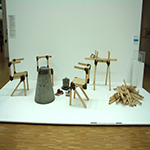
Theatre for Reconciliation: David Hare and David Greig
As a public art form, theatre has long been recognized as a space for the examination and performance of power, protest, intervention, mediation and identity. This paper aims to investigate the relations between the political and the theatrical and to explore the issues of enactment, representation, interrogation and the nature of intervention in two contemporary British plays. Both David Hare and David Greig are occupied and fantasized by The Middle East conflict and thus have produced a number of plays in order to propose exceptional criticism about the prejudices, passions and mutual suspicions.
(Dis)embodied Dualities:Deconstructing Identity in Emi Anrakuji’s 1800 Millimètre Series
Against decontextualized and reductive interpretations of her work, I argue instead that Anrakuji strategically deconstructs gender and sexuality, using them only as an entry point in order to ultimately grapple with deeper and larger issues concerning human identity and existence. Through the objectification of the human body in simultaneously figural and abstract images, Anrakuji both embodies and complicates various dualities associated with gender, sexuality, and humanity.
Tania Bruguera’s Traveling Autobiographies: A Global Performance
My presentation will focus on Autobiography, a piece in two slightly different versions, one to be staged in Cuba and the other, abroad. I will dwell on the Version inside Cuba, held in the Museo Nacional de Bellas Artes during the 8th Havana Biennial (2003). It is this particular work that foregrounds the controversial nature of Bruguera's art which explores the relationship between art, activism and political power. In Autobiography, Tania Bruguera synthesizes image, sound and video, developing new narrative possibilities which encourage the audience to react.
The Collectivity of Art: Collectives of Art, Class War and Peripheral Capitalism in Brazil
This new form of combat and art instruments meant the emergence of artistic collectives. These groups of artists or collectives, in addition to the criticism of art production as individualized production, went beyond to the traditional metier of the visual arts and denied the traditional definition of status of the visual arts to become combative agents in the political and cultural level.
From Scarcity to Emancipation: Renewing the Promise of Post-Industrial Liberation
I will, building upon Rousseau, the Frankfurt School, the American 1960s, and my own work, suggest how we might comprehend, access, nurture, integrate, and build upon this emerging humanity to create communities of creativity and expression, mutuality and democracy, play and engagement. After millennia of quiescent compliance and substitute gratification, advancing beyond the neoliberal cage is the call of our time.
Identity, Diversity, Set Theory: The Design of Concepts and Solutions for a better Future
The paper relates to previous papers about economy, crisis, entrepreneurship versus both socialism and capitalism, employment and the ability of appropriate remuneration, as related to the "culture" of dealing with qualitative diversity and its distinction as well as realisation, and what this means regarding concepts such as education, democracy etc. Having defined as the most important of all equal rights for individuals as well as groups, societies, states and continents, the "equal right of being different", thus, as the right of being, this paper adds another way of explanation as yet another piece to the puzzle of understanding the importance and priority of qualitative diversity and distinction over all, but above all over all merely quantitative aspects and criteria.